 English
 Nederlands
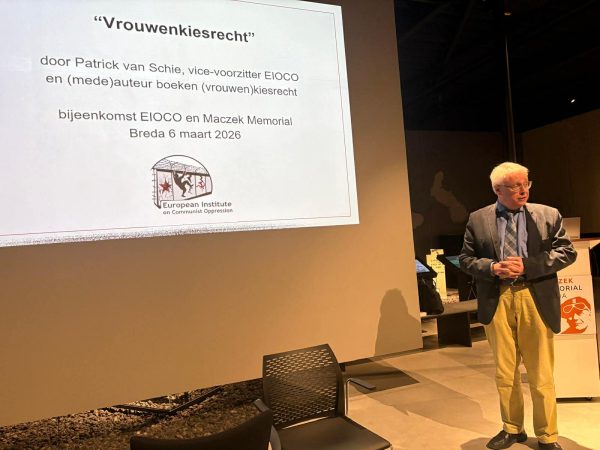
On Friday evening, 6 March 2026, our vice-chairman, Patrick van Schie, delivered a lecture on women’s suffrage at the museum of the Maczek Memorial in Breda. This was part of the “Strijdbare vrouwen, weerbare democratie” (“Combative Women, Resilient Democracy”) activities that the Maczek Memorial is organizing in 2026 around International Women’s Day.
Patrick van Schie first gave a short introduction to the European Institute for the Study of Communist Oppression (Eioco) and its mission. He pointed to the military cemetery commemorating the Polish soldiers who died in 1944–45 during the liberation of the Netherlands, and explained how Poland, like other so-called satellite states in Central and Eastern Europe, was not truly liberated at that time but instead received a new occupier: the Soviet Union. The Netherlands endured five years of oppression under National Socialist Germany, but for the “satellite states” in the Eastern Bloc the oppression lasted ten times as long, since after the German occupation they had to endure decades of communist rule.
Under communism, women had the right to vote just like men, but for both it was completely meaningless. After all, you could only vote for one party—the communist party—or at most for a few entirely subordinate surrogate parties, as in Poland and the GDR. Patrick van Schie’s lecture therefore focused on the path toward women’s suffrage in free, democratic countries. The first country where women gained universal suffrage at the national level was New Zealand (1893); in Europe this first occurred in Finland (1906).
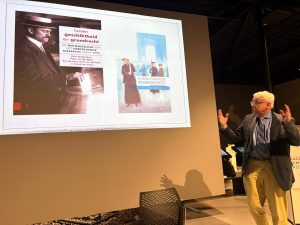
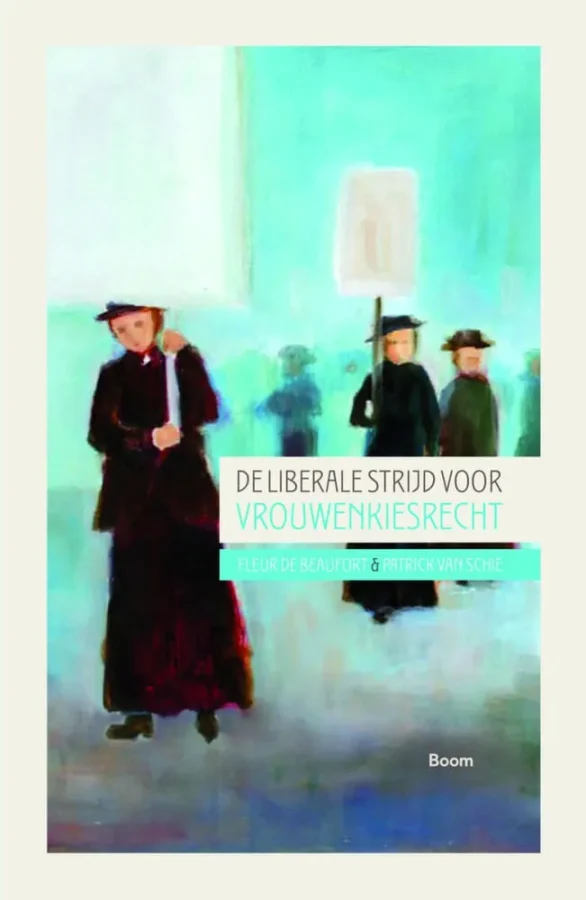
In his lecture, Patrick van Schie discussed the arguments that—already in the 17th and 18th centuries—were raised for and against women’s suffrage, why it was achieved earlier in some countries and later in others, and which political parties tended to support it or resist it the most. In Poland, universal women’s suffrage came about quite suddenly with the restoration of the country’s independence at the end of the First World War, after the country had been absorbed by its neighbors (especially Russia and Prussia) in 1795. On 26 January 1919, all adult women and men were able to go to the polls. Unfortunately, seven years later the country fell into dictatorship.
Patrick van Schie also looked more closely at how the process unfolded in Belgium, Great Britain, and the Netherlands. In the Netherlands, universal women’s suffrage was introduced two years after universal male suffrage, namely in 1919—something that few had expected when male suffrage was introduced. At the same time, he showed, using an early opinion poll from 1920, that alongside women who were delighted with the development, there were also quite a number of women who saw little value in it or were indifferent.
Today, universal suffrage for women and men in our country is fortunately widely accepted. Its value can be best understood by looking at dictatorships where citizens are deprived of free elections with a multi-party system.


Follow Us!