


On February 19 the Parliament of Estonia the Riigikogu passed the Statement “On Historical Memory and Falsification of History” (140 AE) . The statement was submitted by 73 members of the Parliament. 72 members of the Riigikogu voted in favour of the Statement and one member was against. The Statement reads: “Condemning the Molotov–Ribbentrop Pact […]
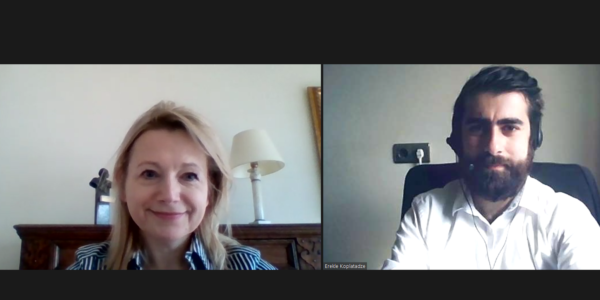
On April 19 EIOCO had an online meeting with the Embassy of Georgia in the Hague. Ms Beata Bruggeman-Sekowska discussed with Mr. Erekle Koplatadze – Communications Officer of the Embassy future joint projects on various niveaus in order to promote the knowledge about communism in the Netherlands.
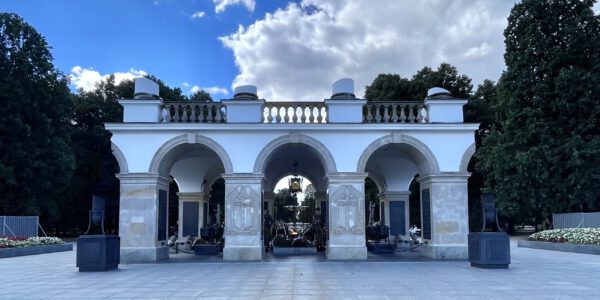
By Beata Bruggeman-Sekowska On November 11, 1918, Józef Piłsudski (Poland’s Chief of State) took over the authority over the Polish army from the Regency Council (in Polish: Rada Regencyjna or Rada Regencyjna Królestwa Polskiego. It was a semi-independent and temporarily appointed highest authority, head of state, in partitioned Poland during World War I). He […]

Beata Bruggeman-Sekowska On 6 September 2025, the beatification of Bishop and martyr Fr. Eduard Profittlich, S.J., took place in Tallinn. He is the first person ever beatified from Estonia, yet his life also shows deep ties with both Limburg in the Netherlands and Poland. From a farming family to the Jesuits Eduard Profittlich was born […]

Book Review of Alan Philps: The Red Hotel by Patrick van Schie Mr. Jones In the 2019 film Mr. Jones, the Metropol Hotel in Moscow is portrayed as a hotbed of disinformation in the early 1930s. Jones is a recently unemployed British journalist, proud of having interviewed Hitler, and now eager to secure an […]

Beata Bruggeman-Sekowska Forty years have passed since the death of Enver Hoxha (April 11, 1985, in Tirana, aged 76). For more than four decades, he ruled Albania with an iron hand, isolating the country from the rest of the world, enforcing strict ideological control and plunging Albania into extreme poverty. His 40-year rule made him […]

By Patrick van Schie On August 1, 1975, leaders of 35 states – from Europe, the United States, and Canada – gathered in the modernist new Finlandia Hall in Helsinki. There, they signed a document of roughly 22,000 words: the Helsinki Final Act. This Final Act was intended to establish new, improved relations between East […]

Book Review by Patrick van Schie A fine addition to the comprehensive works on communism was published last year by American historian Sean McMeekin: To Overthrow the World. A fitting title, as communism does not merely mean revolution—though never in the form of a spontaneous uprising, but always involving the violence of either a coup […]

De Militaire Spectator, the military-academic journal of the Netherlands Armed Forces — has published the article written by Beata Bruggeman-Sekowska entitled “De leugen als wapen: Katyn en georganiseerde desinformatie” (“The Lie as a Weapon: Katyn and Organized Disinformation”). Eighty-five years after the Katyn massacre, the subject remains strikingly relevant. What the Soviets once called desinformatsija […]

Beata Bruggeman-Sekowska “What should I live for? For this system to kill me slowly and mercilessly? It would be better to end my life at once… There will never be freedom here. Even the word freedom has been forbidden.” These were the final thoughts of Romas Kalanta, a 19-year-old night-school student from Vilijampolė, Lithuania, before […]

It has been 80 years since Karl Popper published his book The Open Society and Its Enemies. In his book Popper demonstrated how dangerous the political-philosophical foundations of Marxism already were. Our vice-chairman, Patrick van Schie, discussed the book on the evening of Monday, May 12, with GroenLinks MP Lisa Westerveld at the debate center De […]

On April 12, we were invited as a guest speaker by the General Sosabowski Polish School in Brunssum to the open lesson dedicated to the Katyn Massacre, The event was attended by students, teachers and parents. School Director Ms. Bożena Cichy delivered a presentation on the Katyn massacre, its historical overview and far-reaching consequences.Further, […]

Beata Bruggeman-Sekowska The Katyn Massacre refers to the mass execution of over 20,000 Polish military officers, police officers, and intellectuals, carried out by the Soviet NKVD in 1940. This atrocity occurred after both Germany and the Soviet Union invaded Poland in September 1939: Germany attacked from the west on September 1, while the Soviets invaded […]

By Beata Bruggeman-Sekowska On April 13, 1943, the whole world heard about the crime committed by the Soviets. On that day, the Germans announced the discovery of the graves of Polish officers in the forest near Katyn. Three years earlier, in the spring of 1940, nearly 22,000 prisoners of war captured after the Red Army’s […]
 English
 Nederlands
Follow Us!