 English
 Nederlands
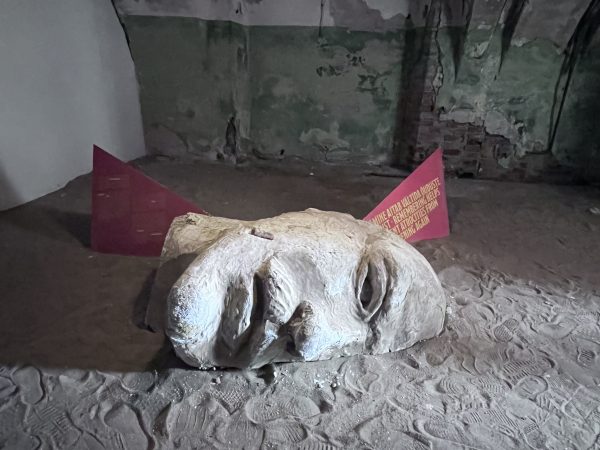
Photo taken at Patarei Memorial Museum for Victims of Communism ©Beata Bruggeman-Sekowska
By Beata Bruggeman-Sekowska
The Estonian people fought for their independence from the Russian Empire between 1917 and 1920. Following the turmoil of World War I and the collapse of the Russian Empire, Estonia declared its independence on February 23, 1918, in Pärnu, with the manifesto published in Tallinn the following day, February 24. This declaration of statehood is commemorated today as Independence Day, a national holiday in Estonia.
The day begins with the flag-raising ceremony at Pikk Hermann Tower early in the morning. The President of Estonia hosts a formal Independence Day reception, during which state decorations are awarded to recipients whose names are published in advance. Since the restoration of independence in 1991, the Estonian Defence Forces have held annual parades, with the first in Tallinn in 1993 marking the 75th anniversary of the 1918 declaration. Both the parade and the presidential reception rotate among different cities each year—for example, Pärnu hosted the celebrations in 2014, and Narva in 2015, the latter featuring contingents from NATO member nations. The military parade, reception, and a preceding concert are broadcast live on national television, including a speech by the President. Local governments often hold similar receptions on February 23, and schools and other institutions sometimes host commemorative events even earlier.
The Estonian Declaration of Independence, also known as the Manifesto to the Peoples of Estonia, was drafted in Tallinn by the Salvation Committee, elected by the elders of the Estonian Provincial Assembly. Originally intended to be proclaimed on February 21, 1918, the announcement was delayed until the evening of February 23 in Pärnu, with a public reading during a political demonstration. The next day, February 24, the manifesto was printed and distributed in Tallinn. At that time, Estonia was caught between retreating Bolshevik forces and advancing German troops, leaving Tallinn free of foreign military presence for only a single day. Although the German Empire occupied Estonia the following day and did not recognize the newly declared republic, Germany withdrew its troops after its defeat in World War I, formally handing power to the Estonian Provisional Government in November 1918. By February 12, 1919, the Provisional Government had already decided that February 24 would be celebrated annually as the anniversary of independence.
Occupation and Oppression
Estonia’s independence was forcibly ended in 1940 when the country was incorporated into the Soviet Union, followed by a brief Nazi German occupation between 1941 and 1944.
During the Soviet occupation, Estonians experienced mass repression. Following the secret Molotov–Ribbentrop Pact of August 23, 1939—an agreement between Nazi Germany and the Soviet Union—Estonia, Latvia, and Lithuania were occupied by the USSR. Between 1941 and 1951, between 30,000 to 75,000 Estonian citizens were deported to remote areas of the Soviet Union, mainly Kazakhstan and Siberia. Two deportations on June 14, 1941 and March 25, 1949 remain particularly significant, with the latter forcibly relocating over 20,000 people, mostly women and children under the age of 16. These events are annually observed as days of mourning in Estonia. The deported were sent without trial or prior notice, often entire families at once. By the end of World War II, Estonia had lost approximately 17.5% of its population due to repression, executions, and deportations.
The Baltic Way
On August 23, 1989, the 50th anniversary of the Molotov-Ribbentrop Pact, approximately two million people from Estonia, Latvia, and Lithuania formed a human chain spanning nearly 700 kilometers from Tallinn through Riga to Vilnius. Known as the Baltic Way, this demonstration symbolized the solidarity and shared desire for freedom among the Baltic peoples. It pressured the Soviet Union to acknowledge the secret protocols of the 1939 pact and became a critical step toward restoring independence.
Restoration of Independence
Estonia formally restored its independence on August 20, 1991, during the Soviet military coup attempt in Moscow. The Estonian Supreme Soviet, in agreement with the Estonian Committee, proclaimed the restoration of the Republic of Estonia, which had been legally established in 1918 but illegally occupied in 1940. The decision was quickly followed by the restoration of diplomatic relations and international recognition of Estonia as a sovereign state. Today, August 20 is celebrated annually as the Restoration of Independence Day.



Follow Us!