 English
 Nederlands
Patrick van Schie
The story of a Soviet “dissident” during the Brezhnev and Andropov eras
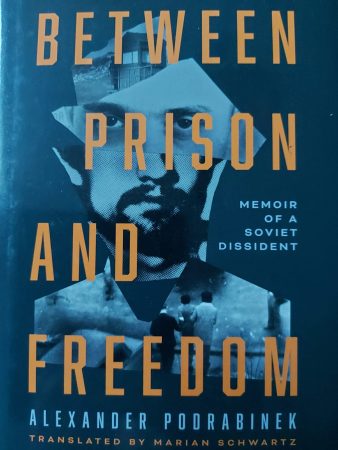
Book summary of Alexander Podrabinek, Between Prison and Freedom. Memoir of a Soviet Dissident (Indiana, 2025), 435 pp.
On February 25, 1956, party leader Nikita Khrushchev denounced the widespread terror of his predecessor Joseph Stalin in a secret – but quickly leaked – speech. In the following years, many prisoners who had not yet died were released from the Gulag – the belt of labor camps in the Soviet Union – but not everyone was freed, and oppression continued. Even after Khrushchev was removed from power in 1964, the persecution of citizens who expressed opinions diverging from communism continued. In Between Prison and Freedom, a dissident from the 1970s and 1980s tells his story. The book was first published in Russian in 2015, and an English edition has recently appeared.
Sasha (Alexander) Podrabinek found himself at a disadvantage in the Soviet Union simply for being a Jewish boy. He further complicated matters by leaving the Komsomol – the youth organization that practically every child was expected to join – after a brief membership, and later consciously refusing to join the Communist Party. His attempt to gain university admission failed as a result. The dean “flipped through my thin file and asked why I was not a Young Communist. I briefly replied that I did not want to be. The dean looked at me thoughtfully and said there was nothing he could do to help me.”
Nevertheless, Podrabinek managed to work in Moscow as a technical laboratory assistant. He became deeply interested in the fate of dissidents imprisoned in psychiatric institutions – a widely used form of punishment for political prisoners during party leader Leonid Brezhnev’s rule (1964–1982). Podrabinek came into contact with many well-known dissidents and described the experiences of about fifteen dissidents confined in psychiatric institutions in his book Punitive Medicine.
Inevitably, this put him in the authorities’ sights. In the latter half of the 1970s, Podrabinek was permanently monitored by the KGB. Wherever he went, KGB agents followed him – “the tail” – not even attempting to do so covertly, but openly spying on him. Sometimes he walked down the street with a KGB agent on each side, conducting a conversation over his head. This open surveillance was meant to intimidate him. Occasionally, Podrabinek managed to temporarily elude his pursuers. This did not immediately lead to consequences, as a KGB agent preferred not to report losing sight of a “target,” which could result in a sanction against the agent.
After a few brief arrests, Podrabinek eventually faced a show trial and was sentenced to exile in a village near Yakutsk, Siberia. After several months, charges were fabricated to justify his imprisonment. Much of his time in several camps was spent in punishment or solitary cells. While many prisoners were destabilized by prolonged confinement without human contact, Podrabinek managed relatively well. Cold, hunger, and loneliness were the gravest enemies of a prisoner, he writes, and he goes into detail about each. Of the three, cold was the worst. “You can overcome loneliness, you can become accustomed to hunger, but it is impossible to become accustomed to cold.” Although a law stipulated that cells should not be colder than 18°C, when prisoners complained, guards presented a thermometer that always read 18°C, regardless of the actual freezing conditions.
Physical torture became less frequent in the late 1970s and early 1980s than under Stalin but did not disappear. Podrabinek recounts instances when he endured such measures. One example he mentions is the exposure of prisoners to chlorine gas in their cells, which not only made breathing difficult at the time but could also cause lasting damage. During his stay in a camp, prisoners received news of Brezhnev’s death, prompting cheers. However, the joy was short-lived, as under Brezhnev’s successor Yuri Andropov, former head of the KGB, camp conditions only worsened.
Toward the end of his sentence, Podrabinek worried whether he would actually be released or if camp authorities, under higher instructions, would fabricate a reason to extend his punishment. The bizarre nature of a totalitarian system like communism became evident when he realized he would indeed be freed. This realization came when his wife informed him that she had discovered KGB listening devices in their apartment. Podrabinek now knew that the “game” with “the tail” was being prepared again, signaling the beginning of another phase of life under monitored freedom.



Follow Us!