 English
 Nederlands

Beata Bruggeman-Sekowska Every year, International Women’s Day is celebrated worldwide, often seen as a positive day for women’s rights and equality. For me and many others born under communism, however, March 8 carries a very different, somber meaning: a day shaped by propaganda rather than genuine emancipation. The origin of this day lies in the […]
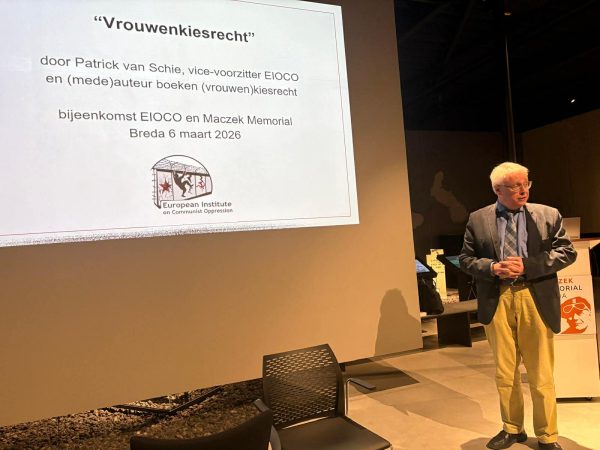
On Friday evening, 6 March 2026, our vice-chairman, Patrick van Schie, delivered a lecture on women’s suffrage at the museum of the Maczek Memorial in Breda. This was part of the “Strijdbare vrouwen, weerbare democratie” (“Combative Women, Resilient Democracy”) activities that the Maczek Memorial is organizing in 2026 around International Women’s Day. Patrick van Schie […]

Beata Bruggeman-Sekowska Stanisława Falkus and Leopolda Ludwig belonged to the Congregation of the Sisters of the Divine Savior (Salvatorians). On 27 January 1945, they were murdered in a chapel by soldiers of the Red Army after having been sexually assaulted. Their beatification process is currently ongoing. Sister Leopolda Gertruda Ludwig SDS Leopolda Gertruda Ludwig was […]
As of 1 January 2026, Czechia has amended its Criminal Code to place the promotion of communist ideology on the same legal footing as Nazism. The change reflects the country’s historical experience with totalitarian regimes and their impact on human rights and freedoms. In a recent interview with Czech Radio, historian Kamil Nedvědický, First Deputy […]

Beata Bruggeman-Sekowska On 6 September 2025, the beatification of Bishop and martyr Fr. Eduard Profittlich, S.J., took place in Tallinn. He is the first person ever beatified from Estonia, yet his life also shows deep ties with both Limburg in the Netherlands and Poland. From a farming family to the Jesuits Eduard Profittlich was born […]

Book Review of Alan Philps: The Red Hotel by Patrick van Schie Mr. Jones In the 2019 film Mr. Jones, the Metropol Hotel in Moscow is portrayed as a hotbed of disinformation in the early 1930s. Jones is a recently unemployed British journalist, proud of having interviewed Hitler, and now eager to secure an […]

De Militaire Spectator, the military-academic journal of the Netherlands Armed Forces — has published the article written by Beata Bruggeman-Sekowska entitled “De leugen als wapen: Katyn en georganiseerde desinformatie” (“The Lie as a Weapon: Katyn and Organized Disinformation”). Eighty-five years after the Katyn massacre, the subject remains strikingly relevant. What the Soviets once called desinformatsija […]

Beata Bruggeman-Sekowska The Katyn Massacre refers to the mass execution of over 20,000 Polish military officers, police officers, and intellectuals, carried out by the Soviet NKVD in 1940. This atrocity occurred after both Germany and the Soviet Union invaded Poland in September 1939: Germany attacked from the west on September 1, while the Soviets invaded […]

By Beata Bruggeman-Sekowska On April 13, 1943, the whole world heard about the crime committed by the Soviets. On that day, the Germans announced the discovery of the graves of Polish officers in the forest near Katyn. Three years earlier, in the spring of 1940, nearly 22,000 prisoners of war captured after the Red Army’s […]

Beata Bruggeman-Sekowska In the heart of Warsaw, a unique institution is dedicated to saving a forgotten piece of history: neon signs. The Neon Museum is more than just an exhibition space—it’s a tribute to Cold War-era electro-graphic design and an effort to preserve the remnants of the state-driven ‘neonisation’ campaign that once illuminated the […]

Beata Bruggeman-Sekowska Located in the basements of the Ministry of Justice at Al. Ujazdowskie 11 in Warsaw, the Cells of the Security Service (Cele Bezpieki) form an essential part of Poland’s historical narrative, highlighting the oppressive tactics used by the Communist regime in the aftermath of World War II. The exhibition, a branch of the […]

By Beata Bruggeman-Sekowska Grzegorz Przemyk (17 May 1964 – 14 May 1983) was an aspiring Polish poet whose untimely death became a powerful symbol of resistance against the Communist regime in Poland. His brutal killing at the hands of the Milicja Obywatelska (Citizens’ Militia) exposed the systemic violence and impunity of the communist authorities during […]


Follow Us!